EV, Hybrid, or Gas: Start With Your Parking Situation, Not Your Ideology
Hey, Logan Pierce here. After writing about short commutes, home chargers, Phoenix heat, and the Tuesday test, it’s time to tackle one of the most practical questions I get: Should I buy an EV, a hybrid, or stick with gas?
My answer always starts in the same place — not with ideology, not with EPA numbers, and not with what’s trending on Reddit. It starts with your parking situation.
Because nothing kills EV ownership faster than bad parking logistics. I’ve seen it too many times in the charging network data.
A good car decision should still feel good on a Tuesday. And on a Tuesday night when you’re exhausted and just want to park and plug in (or not), your parking setup determines everything.
Why Parking Beats Ideology Every Time
I live in a townhouse in Phoenix with dedicated parking and a Level 2 charger already installed. That setup makes EV ownership easy. But I work with people in apartments, shared driveways, and street parking who face very different realities.
The internet loves to argue about EVs vs gas like it’s a moral battle. I don’t. I look at real life.
Your parking situation is the single biggest predictor of whether an EV will feel like freedom or a daily headache.
The Three Parking Realities That Matter Most
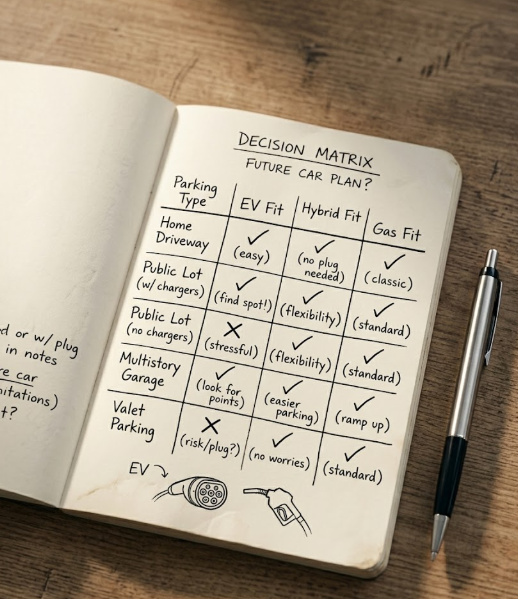
1. Dedicated Spot + Easy Electrical Access (Best Case)
This is my situation. Dedicated parking right outside the townhouse with power available. Installing or using a Level 2 charger was straightforward.
In this setup, EVs shine for commuting. You plug in, forget about it, and wake up with a full battery. Low operating costs and quiet driving become real daily benefits.
2. Apartment or Shared Parking (Challenging Case)
No dedicated spot. Maybe you have to hunt for parking every night. Electrical access? Good luck.
This is where many first-time EV buyers get stuck. They love the idea during the test drive but grow frustrated when they’re running extension cords or relying on public chargers after work. I’ve seen the complaint tickets. It’s rarely pretty at 6:30 PM in 100°F heat.
3. Street Parking or No Reliable Access (Tough Case)
If you park on the street or have no practical way to charge at home, an EV becomes a part-time job. In this scenario, a good hybrid or even a gas car often wins on simplicity and peace of mind.
Real Math From My “Ownership Spreadsheet”
My girlfriend and I ran the numbers recently for a friend in a similar situation:
Scenario A – Townhouse with Charger Access
EV: Strong win on cost and convenience
Hybrid: Still good, but EV pulls ahead
Gas: Only if you need maximum flexibility
Scenario B – Apartment Dweller
EV: High friction, higher effective cost due to public charging
Hybrid: Usually the smartest middle ground
Gas: Simplest if range and refueling ease matter most
The boring math almost always favors whatever option creates the least daily friction.
What I’ve Learned From the Operations Side
Working in charging networks has given me a clear view: People with easy home charging love their EVs. People without it often regret the purchase, even with short commutes.
I’ve diagnosed chargers at rush hour and talked to drivers who bought EVs thinking “I’ll figure charging out later.” Six months later they’re stressed and spending more on public fast charging than they budgeted.
Parking and charging access aren’t side details. They’re the foundation.
When Each Option Actually Makes Sense
Go EV If:
You have reliable home charging (Level 2 preferred)
Your parking is predictable and yours
Your daily commute is under ~40 miles round trip
You plan to keep the car 4+ years
Go Hybrid If:
Parking/charging is uncertain or shared
You want low fuel costs without charging hassle
You drive mixed city/highway routes
You value maximum simplicity on normal Tuesdays
Stick with Gas If:
You frequently take long unplanned trips
Home charging is impossible
Budget is tight and you need the lowest upfront hassle
You live somewhere with poor charging infrastructure
There’s zero shame in any of these choices. The smart decision is the one that fits your life.
My Personal Household Example
When we replaced my girlfriend’s car, her commute is short but her parking at work is unpredictable. We chose a hybrid. No regrets. She leaves work, drives home, parks, and doesn’t think about energy for the next day. On Tuesdays when she’s tired, that simplicity feels excellent.
If we had dedicated Level 2 at both home and work, we probably would’ve gone EV. But we didn’t, so we made the practical call.
Practical Steps Before You Buy
Audit Your Parking Tonight — Be brutally honest about where you actually park every evening.
Check Electrical Access — Talk to an electrician before you shop.
Test Real Routines — Rent an EV for a week and live with it in your actual parking situation.
Run the Full Math — Include installation costs, insurance differences, and public charging fallback.
Think as a Household — If you share decisions, make sure both of you are comfortable.
Bottom Line: Start With Reality, Not Virtue
Don’t buy an EV because it feels like the “right” thing. Buy it because it fits your parking, your commute, and your Tuesday evenings.
Ideology is cheap. Real ownership friction is expensive.
In the Commute category, we’ll keep cutting through the noise with these practical frameworks. Next up, we’ll talk about couples sharing one car and the questions I always ask.
Until then, start with your parking situation. Run your own numbers. Make the choice that still feels good when life is normal and boring.
Because a good car decision should still feel good on a Tuesday — no matter what type of car it is.




No notes on this sheet yet.