When a Hybrid Is the Smarter Buy Than an EV — And That's Fine
Hey, it’s Logan Pierce. After weeks of digging into EV realities — charging friction, range buffers, Phoenix heat, and Tuesday ownership — it’s time to say something that still feels controversial in some circles: sometimes a hybrid is the better choice than a full EV. And that’s perfectly okay.
I work in EV charging network operations. I see the data every day. I also live the reality in Phoenix with my girlfriend. We’ve chosen hybrid for one of our vehicles because it simply fit our life better. No ideology. Just honest ownership math.
A good car decision should still feel good on a Tuesday. If a hybrid delivers that more reliably than an EV for your situation, then hybrid is the right answer.
Why This Conversation Is Still Needed
Too much EV content treats hybrids as a temporary stepping stone or a lesser choice. I don’t. A good hybrid in 2026 is an extremely capable tool that removes most of the friction people struggle with in EVs while still delivering strong efficiency.
From the operations side, I see many drivers who would be happier and less stressed with a hybrid right now. There’s no shame in that.
The Situations Where Hybrid Usually Wins
Here are the scenarios where I often recommend a hybrid over a full EV:
1. Uncertain or Shared Charging Access
If home charging isn’t reliable or easy, a hybrid removes the daily planning. No hunting for plugs. No range anxiety on Tuesdays.
2. Mismatched Couple Schedules
When two people share one car with different hours and parking situations, the coordination required for an EV can become exhausting. A hybrid gives flexibility.
3. Mixed Highway and Errand Driving
If you do a lot of highway miles mixed with short trips, many hybrids deliver excellent real-world efficiency without the heat-related range surprises.
4. Budget and Simplicity Focus
When the total ownership math (purchase price, insurance, maintenance, and mental load) favors the hybrid, it’s the smarter financial decision.
5. Hot Climate with Long Commutes
In Phoenix summers, the combination of heat, speed, and AC can make EV range feel tighter than expected. A good hybrid often feels more predictable.
My Household Example
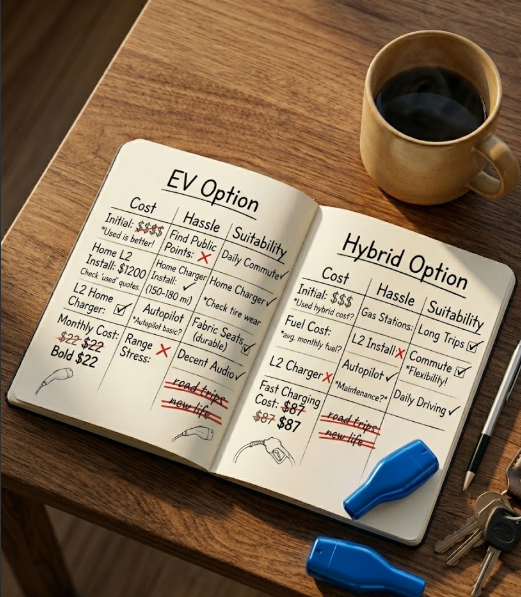
When we replaced my girlfriend’s car, her commute is short but her work parking and schedule are less predictable than mine. We ran the numbers side by side:
EV Option:
Higher upfront cost after incentives, installation expenses, and daily charging coordination.
Hybrid Option:
Lower total monthly cost, zero charging hassle, and excellent real-world fuel economy.
We chose the hybrid. Months later, she still says it was the right call. On tired Tuesdays when she gets home late, the simplicity feels like a gift.
The Real Math Comparison
Let’s be transparent with Phoenix numbers:
EV: Lower fuel cost but higher insurance, potential charger costs, and time spent charging/planning.
Hybrid: Slightly higher fuel cost but simpler ownership, usually lower insurance, and no infrastructure headaches.
For many people with 25-50 mile daily driving and imperfect charging access, the hybrid wins on total cost of ownership and peace of mind for the first 4-5 years.
There’s No Purity Test Here
I love when EVs make sense. I see them working beautifully for people with dedicated home charging and predictable routines. But I also respect when a hybrid is the more rational choice.
Shaming people for choosing hybrid doesn’t help anyone. It just pushes them toward decisions that might not fit their actual life.
The best buyers — the “boring” ones I mentioned before — choose based on their real routines, not what sounds impressive online.
When to Still Choose EV Instead
Reliable Level 2 home charging already available
Predictable short-to-medium commute
Value quiet driving and low maintenance
Plan to keep the vehicle long-term
In those cases, EV is often excellent.
Practical Decision Framework
Before buying anything, ask yourself:
How easy is home charging for me right now?
How much mental load am I willing to accept around energy?
What does the full 4-year ownership math look like?
Will this choice still feel good on a random Tuesday when I’m tired?
Answer honestly. The right tool usually becomes clear.
Bottom Line: Choose What Fits Your Real Life
A hybrid isn’t a compromise. For many normal drivers in 2026 — especially in hot climates or with imperfect infrastructure — it’s often the smarter, more practical buy.
Don’t let hype pressure you into an EV if the numbers and your routine say otherwise. The goal isn’t to be an EV owner. The goal is to have a car that makes your daily life easier.
In the Commute category, we’ll keep focusing on these real decision frameworks. Next time we’ll talk about charging apps and why they often create more confusion than solutions.
Until then, run your own numbers. Be honest about your parking, your schedule, and your comfort level. Choose the vehicle that still feels good on a Tuesday — whether it’s electric or hybrid.
Because a good car decision should still feel good on a Tuesday — no matter what powers it.



No notes on this sheet yet.